




My favorite R&D work is discovering new and unconventional ways to solve long-standing problems, and translating those solutions into meaningful business and product impact.
An FPGA Primer for Software Developers

Introduces FPGA logic design from first principles for software developers, tying it to the high-frequency-trading, offload, storage, and compute workloads FPGAs actually run.


An Interconnect Primer: Unscrambling the Alphabet Soup

A plain-English tour through the interconnect standards and acronyms that trip up software developers working with high-performance networking hardware.

How Hard Could It Be? Understanding Network Traffic at the Picosecond Level

Digs into what network traffic actually looks like once you can see it at picosecond resolution.

Plain Old PTP: Better Than You Think?


Pushes back on the assumption that PTP cannot cut it in a nanosecond world, making the case for what a properly implemented PTP deployment can actually achieve.

How Do You Measure a MAC?


Applies the MAC internals from Part 1 to measure the latency of ExaMAC, the fastest publicly disclosed FPGA Ethernet MAC.
What Is an Ethernet MAC?


Breaks down what a 10G Ethernet MAC actually does, PCS and PMA included, to set up a methodology for measuring FPGA MAC performance.
The Big MAC Mystery: What Is a MAC and How Do You Measure It?

Proposes a precise definition of the minimum feature set of a 10Gb/s Ethernet MAC, and a range of methodologies to accurately and consistently measure MAC latency, cutting through inconsistent vendor performance claims.
A Methodology for Picosecond Scale Measurement of Nanosecond Scale Networks

Brings the series' lessons together into a working methodology, demonstrated by measuring delay through an optical-to-electrical SFP+ module.
How NOT to Measure Nanosecond Scale Networks

Walks through common measurement mistakes, then characterizes the real speed of light through fiber and copper direct-attach cables to show why they matter.
Introducing High Precision Timestamping

Introduces the ExaNIC HPT capture card and a new methodology for characterizing its picosecond-scale timestamping accuracy.
Quantifying Capture Precision and Accuracy

Establishes a bound on how precisely commodity network capture cards can actually measure nanosecond-scale timing.
Picosecond Scale Measurements for Nanosecond Scale Trading

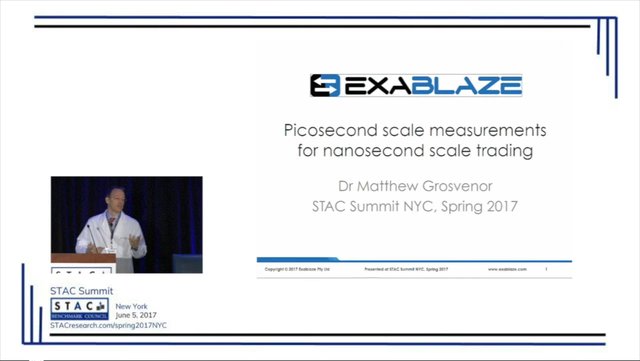
A tour of the challenges, pitfalls, and unexpected findings in measuring trading network latency and jitter down to the picosecond scale, as markets push tick-to-trade times into the low hundreds of nanoseconds.
Queues Don't Matter When You Can JUMP Them!


The NSDI 2015 Best Paper talk on QJump, a scheme that lets latency-sensitive traffic jump ahead of throughput-hungry traffic in the queue.